

FieldPulse is the best HVAC Proposal software for growing residential HVAC businesses, with the strongest all-around proposal toolkit. Jobber suits straightforward professional sales presentations, ServiceTitan leads on advanced pricing and option selling, and QuoteIQ combines strong native presentations with less mature supporting tools.
 This guide compares seven HVAC software platforms for field service management using hands-on desktop and iPhone testing. It covers proposal creation, pricing, mobile limitations, and the handoff from an approved estimate to scheduled work, helping HVAC contractors choose a system that fits both their sales process and their business.
Short Verdict: FieldPulse, ServiceTitan, QuoteIQ, and Jobber are the only field service software options with true HVAC proposal builders that transform simple quotes into sales presentations.
- FieldPulse — Best overall for growing residential businesses. The strongest balance of proposal flexibility, HVAC operations, and room to grow.
- Jobber — Best for straightforward professional proposals. Strong, simple sales presentations, without the advanced comparison and pricing tools of competitors.
- ServiceTitan — Best for large, multi-branch companies. Advanced pricing, reporting, and operating controls; full sales presentations require Airship.
- QuoteIQ — Budget/mobile-AI option with reliability caveats. Strong native presentations and flexible estimating; less mature templates and AI-heavy pricebooks, with no supplier integrations.
The table separates business fit from proposal capability. Prices are the published, observed, or reported figures recorded for this review, in US dollars. They are not equivalent packages: user allowances, billing commitments, add-ons, and implementation fees differ.
| Platform | Best fit | Proposal strengths | Main drawbacks | Pricing basis |
|---|---|---|---|---|
| FieldPulse | Growing residential HVAC contractors | Native sales presentations; Good/Better/Best; estimate options; add-ons; bundles | Pricebook and Dynamic Proposals require the paid Sales Suite | About $99/user/month, before discounts; Sales Suite extra |
| Jobber | Small teams, roughly 6–10 people, needing straightforward professional proposals | Strong, simple sales presentations; optional items; easy mobile quoting | Lacks advanced comparison/pricing tools and dedicated HVAC operations | Connect $99–$130/month; Grow $149–$199/month, each starting with one user; presentation features require Grow |
| ServiceTitan | Large, high-volume or multi-branch businesses | Deep pricing and option-selling tools; full presentations through Airship | Heavy administration and onboarding; separate presentation app and cost | Reported $250–$500/technician/month, plus implementation; Airship reported at $160/user/month plus setup |
| QuoteIQ | Small teams prioritizing broad features and mobile AI | Native branded proposals, multiple estimate types, optional services, mobile AI | Slow loading and offline errors in testing; limited HVAC-specific operations | Pro $149.99/month for four users; Elite $299/month for 10 users; proposal credits may apply |
| BuildOps | Commercial contractors managing complex projects | Multi-version quoting connected to commercial operations | No full sales-presentation builder in the tested workflow; limited option-selling tools | Custom quote; reported around $299+/user/month, depending on headcount and bundles |
| Housecall Pro | Small residential HVAC shops with repeatable jobs | Good/Better/Best, estimate options, add-ons, and financing | Supporting proposal tools rather than the full builder defined here; desktop-to-mobile gaps | HVAC signup test displayed $79/month, versus $59 for handyman; advanced plans, add-ons, and integrations increase the total |
| FieldEdge | Not a first recommendation for flexible proposal creation | Managed flat-rate database; structured replacement options through Proposal Pro | Separate proposal workflow; limited flexibility relative to cost | Reported $100–$125/user/month, plus $500–$2,000 mandatory setup; advanced tools depend on plan/add-ons |
How We Tested HVAC Proposal Software
Testing at a glance
- Review period
- October 2026
- Devices
- Desktop and iPhone
- Evidence
- Trial and paid accounts, with features checked against official documentation.
- Focus
- Creating and presenting estimates, recording customer responses, comparing mobile and office controls, and handing approved proposals into scheduling and invoicing.
- Scope / limits
- Paid modules and integrations are distinguished from included native capabilities.
In October 2026, the Tools in the Wild editorial team tested BuildOps, FieldEdge, FieldPulse, Housecall Pro, Jobber, QuoteIQ, and ServiceTitan using trial and paid accounts on desktop and iPhone. Features were also checked against official documentation. I evaluated their fit for businesses ranging from owner-operators to teams of around 50 technicians.
The review followed the HVAC sales process from estimate creation through presentation, customer response, and operational handoff. I compared what technicians could actually do on mobile with what was available in the office, and considered whether approved proposals could move into scheduling and invoicing without double entry.
The scope is full field service management (FSM) platforms with quoting and proposal workflows, including paid modules and integrations where required. These systems connect sales with functions such as CRM tools, integrated scheduling, dispatch, inventory, and billing. Availability varies: a feature offered through another app is not treated as an included native capability.
Recommendations reflect both proposal quality and the wider HVAC workflow. A platform can create an attractive sales presentation and still be a weak fit for equipment histories, maintenance agreements, or field reliability. Conversely, a strong commercial operations platform may have basic proposal tools.
Read the full Tools in the Wild editorial methodology for more detail.
What Is HVAC Proposal Software?
HVAC proposal software helps contractors create, customize, send, and track offers for heating, ventilation, and air conditioning work. A complete proposal explains the recommended equipment, installation scope, pricing, schedule, warranties, and reasons to choose the contractor.
An estimate calculates an expected cost. A quote specifies an offered price and scope. A bid is an offer submitted for competitive work. A proposal can contain any of these, but also explains the solution and helps the customer evaluate it. The distinction in this review is whether the software supports that broader sales presentation.
A strong presentation can combine equipment specifications, efficiency ratings, warranty details, equipment images, project photos, customer reviews, and company information. These details make professional proposals more useful: customers can understand what they are buying, compare appropriate options, and see what happens after approval.
How to Choose the Best Proposal Software for Your HVAC Business
Start with the way your team sells. A technician quoting a routine repair needs a different workflow from a comfort advisor presenting replacement systems or an estimator preparing a phased commercial project.
I evaluated the key features of these HVAC proposal software tools in three groups:
- Proposal creation: Reusable proposal templates, full sales presentations, Good/Better/Best packages, multiple estimate versions, optional add-ons, pricebooks, and supplier catalogs. I looked for accurate pricing and enough flexibility to explain equipment benefits and installation scope.
- Sales follow-through: Lead management, a visible proposal pipeline, proposal tracking, real-time reporting, automated reminders, customer financing, and checklists or workflows that standardize how the team sells. Customer approval should lead cleanly into scheduled work.
- HVAC operations and value: Equipment records, maintenance agreements, inventory, job costs, and margin visibility, alongside user licenses, required add-ons, setup fees, and billing commitments. I also assessed how much of the workflow was usable on a mobile device.
Pricebooks and supplier catalogs deserve separate attention. A pricebook standardizes saved services, labor rates, and material costs. A supplier integration may add equipment details, availability, real-time pricing, or purchasing, but those capabilities vary by supplier and platform.
Option selling was also important. Good/Better/Best packages, tiered plans, and multi-version quoting let customers compare multiple options at different price points and select suitable upgrades. A 2025 ACCA/Farmington Consulting Group survey of more than 1,000 HVACR contractors associated offering four or more options with higher close rates and a higher share of premium-equipment sales. That supports evaluating how a tool presents choices; it does not establish a guaranteed increase in average ticket size or revenue for any software product.
HVAC Proposal Features Compared
These matrices summarize the tested workflows. Strong means a standout capability in this comparison; Limited means a restriction or workaround. Not established means the review did not confirm the capability, rather than proving it is unavailable. Plan requirements and separate integrations are identified where known.
Proposal Creation and Presentation
| Capability | FieldPulse | Jobber | ServiceTitan | QuoteIQ | BuildOps | Housecall Pro | FieldEdge |
|---|---|---|---|---|---|---|---|
| Quick verdict | Strongest all-around toolkit: native presentations, flexible option selling, custom pricebooks, live suppliers | Strong for straightforward professional sales presentations; lacks advanced comparison and pricing tools | Most advanced pricing and option selling but polished presentations require Airship integration | Strong native presentations and flexible estimating; less mature templates, AI-heavy pricebooks, no supplier integrations | Weakest for proposal selling; multi-version quoting is its only major capability here | Strong option selling, pricebooks, and supplier tools; no native full sales-presentation builder | Templates and extensive repair database; no native presentations, optional add-ons, or advanced package comparisons |
| Full sales-presentation builder | Strong: Native, fully customizable sales presentations | Limited — Native sales presentations with limited customization. | Integration: Customizable sale presentation builder through Airship | Strong: Native, customizable proposals | No | No | No |
| Templates | Yes | Yes | Limited; office setup required for mobile use | Limited; saved templates could not be edited or renamed | No reusable proposal-template capability established | Yes | Yes |
| Estimate Options / Multi-Version Estimates | Yes | No | Yes | Yes | Yes | Yes | Limited; advanced options through Proposal Pro/HVAC BizPro |
| Good/Better/Best | Yes | No | Yes | Limited; Options and packages approximate the workflow | No | Yes | Limited; Proposal Pro integration |
| Optional add-ons | Yes | Yes | Yes | Yes | No | Yes | No |
| Pricebooks | Strong — Native pre-built pricebooks, import support for flat rate pricebooks, fully customizable pricebook creation. | No | Strong – Native pre-built pricebooks with sales explainer PDFs, import support for flat rate pricebooks, fully customizable pricebook creation, and AI-generated smart recommendations and regional pricing averages. | Limited — Pricebook relies heavily on AI generated content but included free in base price. Support for pricebook imports and creation | No | Strong — Native HVAC pricebooks, integrations with flat rate pricebooks like Profit Rhino and The New Flat Rate, customizable pricebook creation. | Limited — Has an expansive list of 25,000+ repairs and parts inside FieldEdge Flat Rate that regularly updates. Can be difficult to customize. |
| Supplier catalogs | Yes — Live pricing integrations with suppliers like Reece, Trane, and American Standard with live, in-app procurement, pricing, availability. | Limited — Jobber only has a native Home Depot integration that lets you search products and pricing directly within quotes. Other options like Ferguson are available through the Ply integration | Yes — ServiceTitan offers live supplier pricing integrations with a multitude of suppliers, though capabilities vary by supplier and in-app procurement is still in development. | No | No | Strong — Native HVAC pricebooks, integrations with flat rate pricebooks like Profit Rhino and The New Flat Rate, customizable pricebook creation. | Limited — Connects to Ply to purchase from suppliers like Ferguson, offers discounts for Carrier products, and supports Mingledorff’s live pricing, parts requests and replenishing. |
“Full sales-presentation builder” uses the definition near the verdict. A platform can support equipment comparisons, branding, or attached sales materials without providing the same presentation-building workflow. Paid modules within an app and separate third-party apps are distinguished because they affect both cost and daily use.
Sales and HVAC Operations
| Capability | FieldPulse | Jobber | ServiceTitan | QuoteIQ | BuildOps | Housecall Pro | FieldEdge |
|---|---|---|---|---|---|---|---|
| Lead management and sales pipelines | Yes | Yes | Yes | Yes | Yes | Yes | Yes |
| Mobile proposal workflow | Strong: Proposal templates supported, strong offline capabilities | Limited: Basic quotes work well; presentation customization is reduced | Limited; office setup and reduced mobile workflow | Broad functionality, with loading and offline reliability problems in testing | Not established for full proposals | Limited; important desktop features unavailable | Advanced proposals use a separate site |
| Customer financing | Yes | Yes | Yes | Yes | Yes | Yes | Yes |
| Automated reminders and follow-ups | Yes | Yes | Yes | Yes | Yes | Yes | Yes |
| Equipment records | Strong: Detailed assets and history | No although certain workflows can approximate | Strong: Equipment records and refrigerant workflow | No although certain workflows can approximate | Strong: Assets and refrigerant records | Limited; very basic equipment records | Yes |
| Maintenance agreements | Strong | No although certain workflows can approximate | Strong | No although certain workflows can approximate | Yes | Strong | Yes |
FieldPulse: Best Overall for Growing Residential HVAC Businesses
Verdict: FieldPulse is my pick for the best HVAC proposal software for growing teams, balancing proposal flexibility, HVAC-specific operations, and room to grow. It is more adaptable with more feature depth than simpler residential tools, supports simple commercial work, and is less expensive and demanding to implement than ServiceTitan.
For an HVAC business, its main strength is the range of ways to present an estimate. Dynamic Proposals turn pricing into a branded sales presentation, while estimate options, optional add-ons, Good/Better/Best packages, and bundled services support different HVAC sales approaches.
Main trade-off: Pricebook and Dynamic Proposals require the paid Sales Suite. The base subscription alone does not include the complete proposal software toolkit discussed here.
HVAC Proposal Capabilities
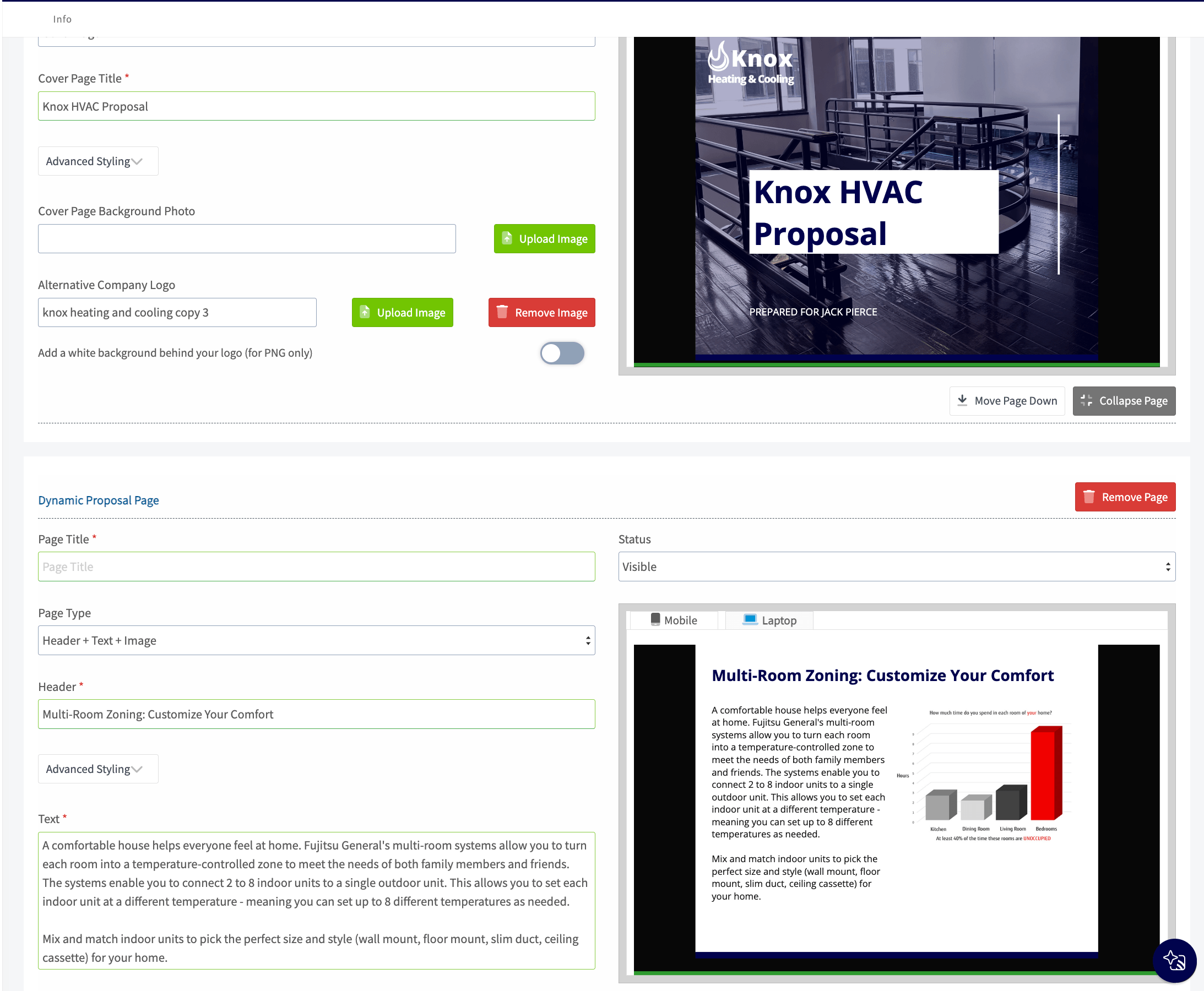
- Create custom or flat-rate estimates from labor, materials, and reusable service items.
- Use Dynamic Proposals for covers, company introductions, photos, reviews, contracts, e-signatures, and supporting sales information.
- Present alternative packages, optional add-ons, and Good/Better/Best offers at multiple price points through Variant Proposals.
- Reuse proposal templates for HVAC proposals on desktop and mobile.
- Organize parts and services with Bundles and Groups.
- Import a prebuilt HVAC pricebook or create a custom one.
Supplier connections are key features for HVAC contractors who need more detailed equipment selection. The Reece HVAC integration provides a live digital pricebook with equipment pricing and system match-up information. Trane and American Standard connections broaden the available supplier workflows.
Price and Value
FieldPulse costs around $99 per user per month before discounts. Reported pricing for Sales Suite and Custom Forms was $85–$100 per month in addition to the subscription; confirm the bundle and billing basis in a written quote. Premium support was reported at $795, with no mandatory implementation fee identified in this review.
When comparing HVAC proposal software, the per-user price can look higher than a competitor’s entry package, but native contracts and inventory are included in the base subscription. That improves its overall value when a competing setup would need separate apps for those functions.
For context, pricing gathered for this review placed DocuSign around $10–$20 per month and Ply inventory around $140–$160 per month, depending on configuration. One Ply configuration started at $140 for two locations, such as a truck and a warehouse, plus $60 for each additional location. These are separate products with different plans, not automatic costs for every alternative.
HVAC Operations and Supporting Sales Tools
FieldPulse’s operational depth is a major reason I recommend its proposal software to growing HVAC companies:
- Service agreements: Connect contracts, recurring billing, shared files, and service reminders.
- Equipment histories: Store warranties, condition, custom fields, photos, files, and service records, including ownership transfers when a property changes hands.
- Forms and workflows: Convert PDFs into fillable forms or build forms with signatures, images, dropdowns, and conditional logic. These support technician checklists, rebate applications, and inspection paperwork; Custom Forms carries an additional cost.
- Field references: Keep PDFs, photos, and reference materials in shared file libraries.
- Dispatch and projects: Match technician skills and certifications to work orders, and manage light commercial work with milestones, assignments, and job costing.
CRM tools including lead pipelines, lead-source tracking, custom stages, proposal tracking, and automated follow-up give the sales team visibility into HVAC sales opportunities. Detailed asset records carry customer data into future visits. Before taking on more jobs, check how accepted work carries through to job costs and profit margins.
See the HVAC equipment tracking software and HVAC service agreement software comparisons for closer workflow tests.
Jobber: Best for Straightforward Professional Sales Presentations
Verdict: Jobber is a strong choice of HVAC proposal software for straightforward, professional sales presentations, although it lacks the advanced comparison and pricing tools of competitors. It is easy to learn and suits small residential HVAC shops of roughly 6–10 people with simple sales and operational needs.
Jobber qualifies as a sales proposal tool because Advanced Quote Customization adds content around the price. That does not make it a sophisticated equipment-comparison tool: presentation customization and pricing flexibility are different capabilities.
Main trade-off: The strongest presentation features are on the web, while dedicated HVAC pricebooks, equipment histories, maintenance agreements, and complex option selling remain missing or limited.
HVAC Proposal Capabilities
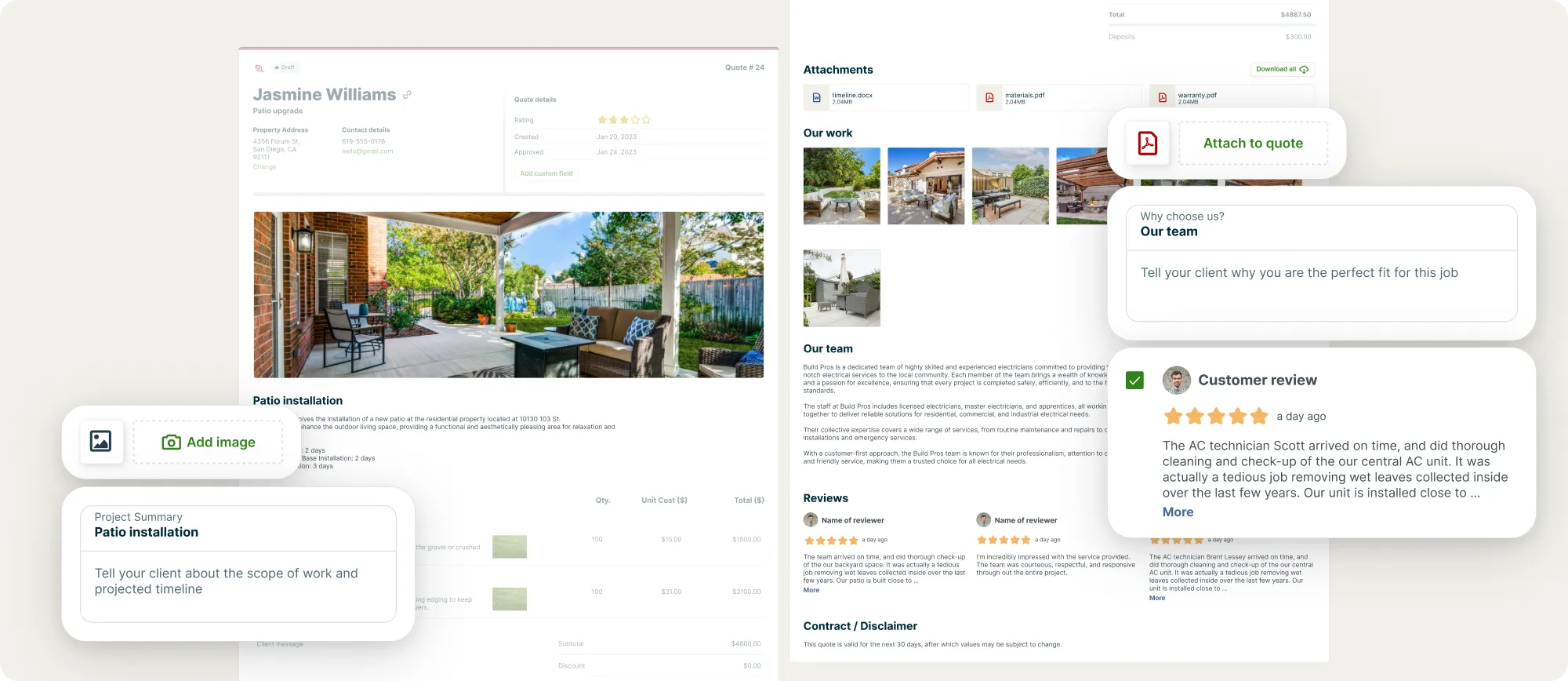
Jobber’s key features for HVAC proposals include reusable quote templates and optional line items that customers can select. Advanced Quote Customization adds introductions, header images, photo galleries, attachments, and Google reviews. The complete customization experience is available on the web with Grow and Plus; mobile customization is reduced.
It lacks dedicated Good/Better/Best packages, multiple full estimate options, and the specialized pricing workflows available in FieldPulse and ServiceTitan. Its strength as proposal software is producing a clear sales proposal without much setup.
The native Home Depot integration lets users add catalog products, equipment images, pricing, and local availability to quotes. Supplier connections can help compensate for the lack of a dedicated pricebook; other suppliers, such as Ferguson, depend on an integration such as Ply.
Price and Value
HVAC contractors will generally want at least Connect, starting at $99–$130 per month, for QuickBooks integration and automated quote follow-up. Advanced presentation customization and optional add-ons require Grow, starting at $149–$199 per month. These starting prices include one user; compare the actual package for your full crew rather than assuming it covers 6–10 people.
Potential additional costs recorded for this review include Sales Pipeline at $49 per month unless included with Plus, DocuSign at $10–$20 per month, and a Ply inventory configuration around $160 per month. Billing terms and user allowances affect the comparison.
Jobber can be good value for an HVAC business with simple needs. The best HVAC proposal software for that buyer should be easy to maintain; as inventory, contracts, and advanced sales workflows require additional subscriptions, its value advantage narrows.
HVAC Operations and Supporting Sales Tools
Recurring jobs and billing can approximate ongoing service agreements, but there is no purpose-built HVAC maintenance-agreement workflow. Equipment tracking relies on custom fields, notes, and photos instead of structured asset records, making growing service histories harder to manage. Full inventory control and formal contract workflows require separate integrations.
Jobber includes financing and automated reminders, while paid Sales Pipeline adds visibility into leads and open proposals. Its proposal software supports a straightforward HVAC sales process, with less depth for complex equipment choices and multi-stage operations. A sales team seeking more deals should test whether optional items explain the offer clearly enough for its customers.
ServiceTitan: Best for Large, Multi-Branch HVAC Companies
Verdict: ServiceTitan offers the most advanced pricing and option-selling tools in this HVAC proposal software comparison, but polished sales presentations require the separate Airship integration. It is the strongest fit for large, high-volume HVAC businesses that need standardized processes, detailed reporting, and control across branches.
The estimating tools connect to extensive equipment records, maintenance agreements, inventory, and financial reporting. That makes ServiceTitan more than a sales proposal tool, but also makes it substantially harder to implement and administer.
Main trade-off: Full branded sales presentations require the separate Airship integration. The core platform also demands ongoing work on pricebooks, permissions, reporting, and operating procedures.
HVAC Proposal Capabilities
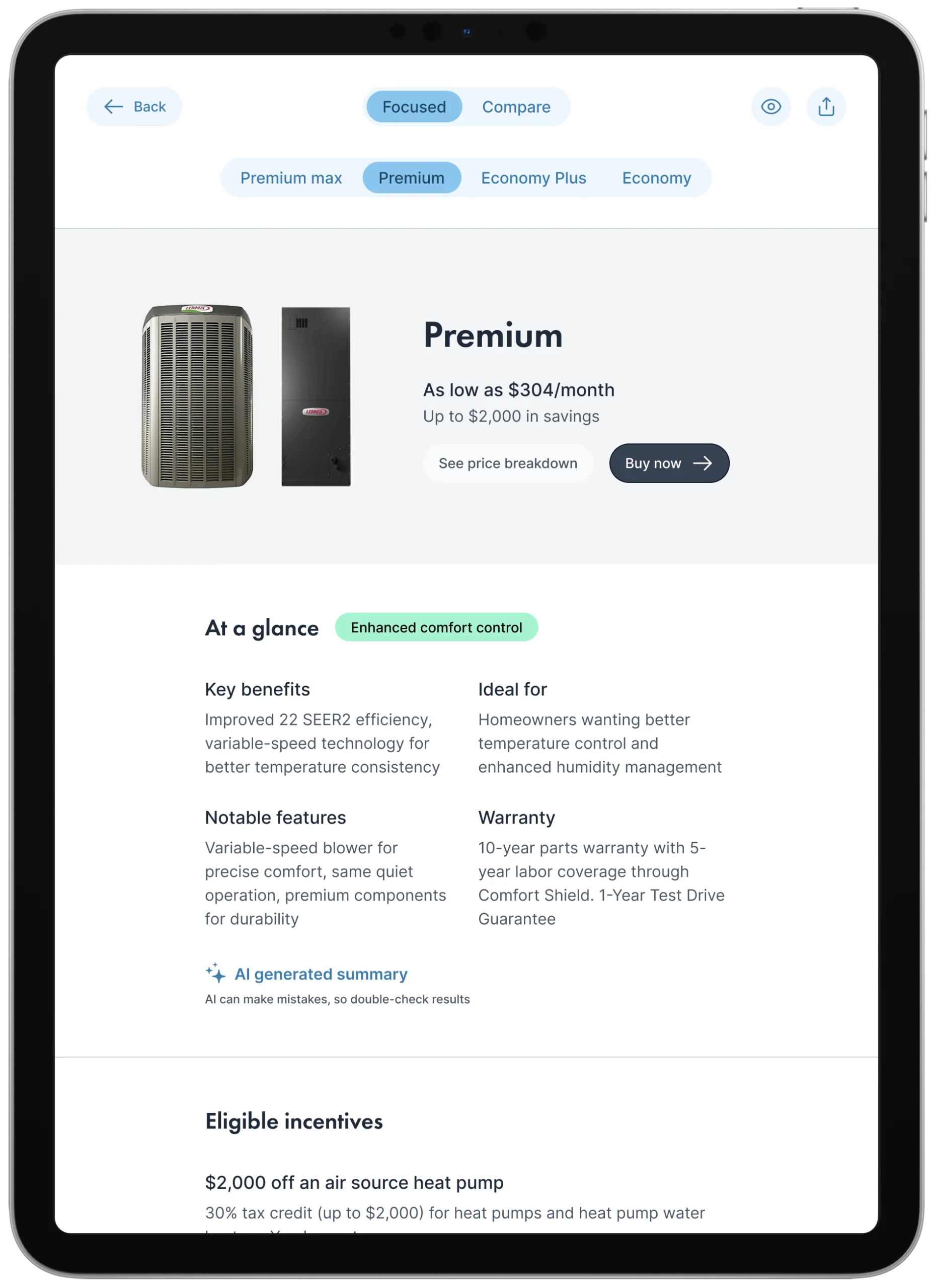
ServiceTitan supports a centralized pricebook, estimate templates, multiple estimate options, Good/Better/Best packages, optional services, and supplier connections including Ferguson and Trane. Key features include configurable services, equipment and labor, sales explainer PDFs, AI recommendations, and regional pricing information. In a demo, have the HVAC sales team check how labor rates affect the options it presents and whether accepted options transfer without double entry.
HVAC contractors comparing proposal software should pay particular attention to mobile availability. Estimate templates must be grouped into proposal templates in the office before they appear in the mobile workflow. A feature available to office staff is not necessarily equally usable by an owner-operator managing the business from the field.
Airship supplies the full sales proposal workflow: branded documents with cover letters, company information, customer reviews, and other supporting material. It also uses AI to identify available customer rebates. Airship is a separate platform connected to ServiceTitan, with reported pricing of $160 per user per month plus an initial setup fee.
Price and Value
Reported ServiceTitan pricing is approximately $250–$500 per technician per month. A mandatory implementation fee can reportedly range from $5,000 to $50,000 or more, depending on company size, data complexity, and setup. Add-ons and Airship increase the total.
For most smaller HVAC businesses, I do not think this proposal software setup’s added depth justifies the cost and administration. FieldPulse covers many of the same operational categories for less, although it may require more manual configuration. BuildOps is the stronger fit for complex commercial projects.
For larger HVAC companies comparing enterprise platforms, centralized controls can justify the investment. The best HVAC proposal software for that buyer must fit branch-level oversight as well as individual presentations. Enterprise Hub brings revenue, booking rates, sales, conversion rates, and call-center performance into one view across locations and business units. Central pricebook management standardizes services, materials, and equipment while controlling local editing permissions. Updates can flow into configured dynamic estimate templates.
HVAC Operations and Supporting Sales Tools
ServiceTitan handles substantial repair, replacement, and maintenance workloads, including commercial work. Its tools for service agreements connect member discounts to pricebooks and membership types, rather than relying on recurring-job workarounds.
Its refrigerant-tracking workflow can record quantities added, recovered, recycled, or disposed of, with equipment and job context. Native inventory also distinguishes it from Jobber, Housecall Pro, and FieldEdge in this comparison; FieldPulse, BuildOps, and QuoteIQ offer native inventory as well, subject to their package requirements.
Lead tracking, financing, unsold-estimate follow-up, and HVAC sales reporting connect customer acquisition to completed work. Paid Marketing Pro adds email and text campaigns for unapproved proposals, membership renewals, and other opportunities. Its marketing tools are less specialized than dedicated marketing software, but connect activity to booking, technician performance, and revenue.
This HVAC software is most effective when the business can support the configuration, permissions, reporting, and training that this depth requires. It is a difficult starting point for an owner-operator seeking a gradual path into more advanced processes.
QuoteIQ: Broad Proposal Tools and Mobile AI, With Reliability Trade-Offs
Verdict: QuoteIQ combines strong native HVAC proposals with flexible estimating, but its supporting capabilities are less mature. Templates have editing restrictions, pricebooks rely heavily on AI, and supplier integrations are missing. Loading delays, offline errors, and less developed HVAC workflows kept it from being one of my preferred HVAC proposal software choices, despite its broad feature set.
QuoteIQ was the only platform whose AI quoting features worked on a mobile device during my testing. Comparable functions in the other tested platforms were unavailable in the mobile workflow or still in development. This is a finding about the tested versions and accounts, not a claim that other vendors have no AI features.
Main trade-off: For HVAC technicians, feature breadth did not consistently translate into a smooth field experience. After I enabled offline mode, previously loaded estimates disappeared from view, and attempts to create a new estimate repeatedly returned errors. Routine tasks also had frequent 6–10-second loading delays.
HVAC Proposal Capabilities
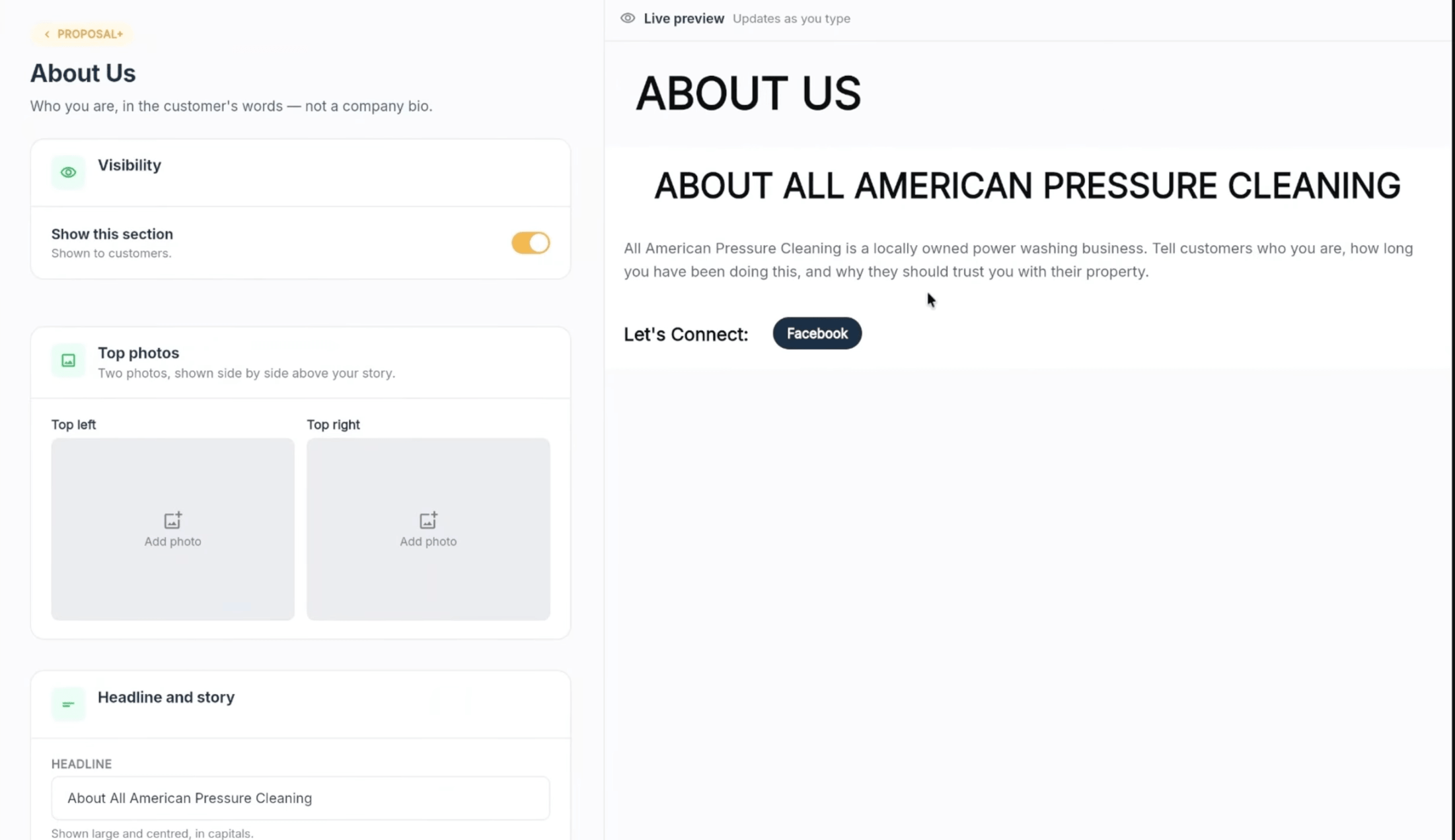
QuoteIQ bundles four estimate types—Standard, Quick, Options, and Package estimates—with supporting proposal software:
- Standard and Quick Estimates: Detailed itemized quotes or simpler estimates for routine work.
- Options and Optional Services: Alternative scopes plus selectable extras, such as duct cleaning or a thermostat upgrade.
- Package Estimates: Bundled services at multiple price points that approximate a Good/Better/Best workflow. This is less specialized than the dedicated comparison tools in stronger HVAC platforms.
- Branded proposals and Proposal+: Company information, service descriptions, photos, documents, and reviews around the sales proposal. Proposal+ converts estimates into customizable branded presentations.
- AI-assisted estimating: Generate a draft and revise its content, including from mobile.
- Templates and pricebooks: Reuse saved material, import pricing, or build a pricebook. Saved templates could not be edited or renamed, and the pricebook leaned heavily on AI-generated content.
These key features cover much of the HVAC sales process, but some felt less refined than their counterparts. AI output also needed review; it did not replace checking equipment suitability, labor rates, and material costs to protect profit margins when preparing detailed proposals.
Price and Value
Pro costs $149.99 per month for four users. Its QuickBooks integration supports QuickBooks Online synchronization; QuickBooks Desktop is not supported.
Elite costs $299 per month for 10 users and adds native inventory, sales pipeline, and customer self-scheduling. AI consumes each plan’s monthly IQ Credit allowance. Branded proposals cost 100 IQ Credits each on Pro and lower plans; Elite and Max waive that proposal charge.
Those user allowances can make QuoteIQ attractive for a team. For one person who needs Pro-level functionality, $149.99 per month is harder to justify against competitors starting around $100. For an HVAC business choosing proposal software, the required features, seat count, and proposal-credit costs determine value.
HVAC Operations and Supporting Sales Tools
QuoteIQ was built with pressure-washing businesses in mind and felt more general-purpose than deeply HVAC-specific in testing. It lacks a dedicated maintenance-agreement system, structured HVAC asset management, refrigerant tracking, and supplier price synchronization. Subscription workflows can approximate recurring service, but do not offer the same control as a purpose-built maintenance plan.
Automated follow-up, financing, custom forms, and other customer-facing tools are available; Elite adds the sales pipeline and self-scheduling. The broad toolkit can suit small HVAC contractors who prioritize mobile quoting, but the observed reliability problems matter when a technician needs to work without a dependable connection. To assess this HVAC software, repeat the same sales proposal with and without a signal before relying on it for more jobs.
BuildOps: Strong Commercial Operations, Weak Proposal Selling
Verdict: BuildOps is the weakest HVAC proposal software option here for presentation-led selling; multi-version quoting is its only major capability in that area. Its reason to be on the shortlist is commercial project management, not a full sales-presentation builder.
Unlike platforms adapted from residential service, BuildOps was built for commercial specialty contractors. Commercial HVAC contractors should consider it when construction documentation, crew planning, project finances, and complex account management matter more than presentation flexibility.
Main trade-off: That commercial depth can add more expense and complexity than HVAC companies need for straightforward jobs. A phased school renovation with subcontractors, approvals, and changing scope is a better example of its strengths than a simple rooftop-unit replacement.
HVAC Proposal Capabilities
BuildOps supports basic estimates and multiple quote versions, but lacks the Good/Better/Best comparisons, optional add-ons, and full branded sales presentations that distinguish stronger proposal tools.
Choose BuildOps when a basic sales proposal is sufficient and the surrounding commercial HVAC project workflow is the more important purchasing criterion. Its key features serve project execution more than persuasive HVAC sales presentations.
Price and Value
BuildOps uses custom pricing based on headcount and required features, so HVAC contractors need a quote for the complete setup. Reported costs are around $299 or more per user per month, with Project Management, Financials, Sales & CRM, and other bundles changing the total.
Implementation and onboarding are included in the pricing described for this review, although legacy data migration and specialized workflows can affect the quote. Its cost makes more sense for commercial HVAC companies using the advanced project, field service, and financial tools alongside proposal software. FieldPulse provides enough project functionality for lighter commercial work at a lower cost.
Commercial HVAC Operations and Supporting Sales Tools
BuildOps stands out when several crews, subcontractors, phases, and billing cycles need to stay coordinated:
- Construction documents: Connect drawings, RFIs, submittals, change orders, and budgets so crews can work from current information.
- Change-order control: Track approved scope changes and their effects on revenue, job costs, purchasing, and subcontract commitments.
- Committed costs: Link purchase orders and subcontracts to phases and cost codes, making already-committed spending visible before the invoice arrives.
- Project finances: Compare forecasts with budgets, track work in progress, and monitor profit margins and over- or underbilling.
- Crew planning: Allocate labor by phase, skill, and cost code, with a shared view of assignments and gaps.
- Field and asset tools: Use equipment history, diagnostic assistance, schematics, and guided repairs. Refrigerant records can be captured through forms and inventory linked to asset histories.
Ongoing service agreements, equipment records, and skill-based dispatch complement those project tools. CRM+ links opportunities to properties, contacts, assets, proposals, and files. The HVAC sales team can track stages and overdue follow-ups; managers can monitor quote statuses and close rates. Assess whether this visibility helps pursue more deals without losing control of project commitments. Technicians can flag additional work, while OpsAI can identify repair or replacement opportunities in visit notes and support follow-up.
Housecall Pro: Strong Supporting Tools, Without a Full Presentation Builder
Verdict: Housecall Pro has strong option-selling, pricebook, and supplier tools, but lacks a native builder for full sales presentations under this review’s definition. It can suit small residential HVAC shops with repeatable jobs, yet is not my HVAC proposal software recommendation when a customizable sales document is the main requirement.
Its strengths include visual replacement options, maintenance-plan sales, financing, and a structured residential HVAC sales workflow. The limitations become more noticeable when estimates need greater flexibility or are built primarily in the field.
Main trade-off: Important desktop capabilities are missing from the mobile app, including estimate cost and profit calculators, built-in image libraries, and AI-generated descriptions in the tested workflow.
HVAC Proposal Capabilities
Housecall Pro offers a substantial set of key features for HVAC proposals:
- Custom and flat-rate estimates built from line items and saved services.
- Multiple scopes and prices within one estimate.
- Good/Better/Best comparisons that can be presented on mobile or sent by text and email.
- Reusable desktop and mobile templates.
- Optional add-ons and customer financing.
- Custom pricing forms, created on desktop, that can support customer-generated estimates through the booking portal.
Its pricebook options include native HVAC content, custom creation, and integrations such as Profit Rhino and The New Flat Rate. Reece and Home Depot connections add supplier pricing and purchasing. In the reviewed integrations, Reece pricing and availability were not real-time, while Home Depot’s were.
Those features make this HVAC software capable at presenting choices. They do not provide the same freedom to build a full sales proposal as FieldPulse, QuoteIQ, or Jobber, or ServiceTitan paired with Airship.
Price and Value
In my September 2026 signup test, choosing HVAC increased the displayed starting price from $59 to $79 per month compared with choosing handyman. I could not identify a feature difference between the two accounts; the HVAC pricebook was available in both.
That test captures a specific signup experience, not a universal price for every billing term or offer. Higher plans, premium add-ons, and integrations can make the configured system substantially more expensive. The combinations considered in this review could take costs above $100–$200 per user per month, so HVAC contractors comparing proposal software cannot judge value from the headline starting price alone.
For me, the trade-based premium was difficult to justify when several HVAC-specific functions remained less detailed than competitors’ equivalents. The best HVAC proposal software for a small team should justify its configured cost through the work that team actually performs.
HVAC Operations and Supporting Sales Tools
Housecall Pro supports maintenance agreements, HVAC pricebooks, and Property Profiles with basic equipment details. These cover routine residential service calls but lack the asset and operational depth of FieldPulse, BuildOps, and ServiceTitan.
Lead tracking, automated follow-up, financing, approvals, and job or estimate checklists support a standardized sales process. It is easiest to adopt when that prescribed workflow already fits the HVAC business; flexibility becomes more important as jobs and equipment histories become more complex. Before adding more jobs, check that the proposal software passes the agreed scope to the people doing the work.
The HVAC service agreement software comparison examines those recurring-service workflows in more detail.
FieldEdge: Templates and Repair Pricing, With a Separate Proposal Workflow
Verdict: FieldEdge provides templates and an extensive service and repair database, but lacks native sales presentations, optional add-ons, and advanced package comparisons. I do not recommend it as a first choice of HVAC proposal software for HVAC companies prioritizing flexible proposal creation.
Proposal Pro adds structured replacement-proposal capabilities through a separate workflow for the HVAC sales team. That distinction matters: its features should not be presented as native FieldEdge functionality or equated with the full presentation-building experience of the stronger options.
Main trade-off: Higher costs are difficult to justify against more flexible competitors, and creating or revising advanced proposals introduces additional application and account steps.
HVAC Proposal Capabilities
- FieldEdge Flat Rate: The renamed Coolfront pricebook supplies a managed database of 25,000 repairs, according to its official page. It supports repair pricing but was less flexible to customize than stronger pricebooks in this comparison.
- Multi-option quotes: Available through Premier.
- Proposal Pro: Adds Good/Better/Best and budget options, templates, equipment descriptions, reviews, custom covers, and embedded videos through its separate integration.
Advanced HVAC proposals require launching Proposal Pro from a FieldEdge work order, signing in with a matching Sales Rep account, and sending from the Proposal Pro website. Changes before scheduling the accepted work also happen there. Emailed and accepted statuses synchronize back to FieldEdge, but the separate sales proposal workflow adds friction. During a demo, check whether customer data and scope changes transfer without double entry.
FieldEdge’s supplier connections include Ply for purchasing from suppliers such as Ferguson, Carrier discounts, and Mingledorff’s pricing, parts requests, and replenishment tools. Those connections differ from the managed FieldEdge Flat Rate catalog; current supplier pricing and a standardized repair database serve different purposes.
Price and Value
Reported pricing is $100–$125 per user per month, plus a mandatory setup fee of $500–$2,000. Premier adds multi-option quotes and advanced service agreements. Elite includes Proposal Pro and MarketingEdge; both can also be purchased as add-ons to lower tiers.
FieldEdge lacks the proposal flexibility or enterprise controls that would justify its cost for my recommended buyer profiles. Existing users may value its established workflow, but HVAC contractors should compare alternatives before adopting it primarily as proposal software.
HVAC Operations and Supporting Sales Tools
FieldEdge supports service agreements, equipment records, dispatch, invoicing, lead tracking, HVAC sales reporting, financing, and automated follow-up. Marketing tools add customizable email campaigns.
Full warehouse inventory requires QuickBooks Desktop Enterprise with Advanced Inventory, rather than an included native FieldEdge inventory system. That can suit an established QuickBooks Desktop setup, but creates another dependency for HVAC companies seeking integrated cloud proposal software.
Frequently asked questions
Which tools support Good/Better/Best HVAC proposals?
FieldEdge, FieldPulse, Housecall Pro, and ServiceTitan support dedicated Good/Better/Best workflows. QuoteIQ uses options and packages to approximate the approach. Jobber’s optional line items are useful for add-ons, but are not a dedicated package-comparison builder; BuildOps lacks this capability in the tested workflow.
What does HVAC proposal software cost for a five-person team?
There is no single useful industry average because plans charge by different combinations of users, features, and data migration needs. But on average, you should expect to pay an average of around $80-$125 per user per month – not including potential onboarding fees.
Which proposal features require an additional subscription?
FieldPulse’s Pricebook and Dynamic Proposals require Sales Suite. Jobber’s advanced quote customization requires Grow or Plus, and Sales Pipeline can be a separate charge. ServiceTitan’s full sales presentations use Airship; Marketing Pro is another paid product. FieldEdge’s advanced workflows depend on Premier, Elite, or add-ons. Housecall Pro also places capabilities in higher plans and add-ons. QuoteIQ charges proposal credits on Pro and lower plans, while Elite and Max waive that charge.
Can I create and send HVAC proposals from the field?
Yes, but HVAC proposal software varies substantially in mobile capability. For example, Housecall Pro and ServiceTitan have important desktop-to-mobile restrictions. QuoteIQ offers broad mobile functionality including access to its AI features but had trouble loading and offline problems in testing. And Jobber and FieldPulse offered great desktop to mobile experiences for owner-operators in the field.
Does HVAC proposal software integrate with QuickBooks?
All seven platforms support some form of QuickBooks integration, but the version, plan, and sync behavior differ. QuoteIQ, for example, supports QuickBooks Online on Pro and higher plans, but not QuickBooks Desktop. When testing proposal software, check customer records, taxes, line items, and approved estimates to understand what moves automatically and where manual re-entry remains.
Which software should commercial HVAC contractors use?
BuildOps is the strongest fit here for complex commercial HVAC projects, with deeper construction documents, committed-cost tracking, phased billing, and crew planning. ServiceTitan fits large service organizations seeking centralized pricing, reporting, and operating controls. BuildOps’ project strengths do not make it the stronger proposal builder; HVAC contractors should choose proposal software according to which workflow matters most.
Does HVAC proposal software save time and help teams make fewer errors?
HVAC proposal software can save time once pricebooks, reusable service items, and proposal templates are configured. These tools help teams create accurate proposals with fewer errors, reducing missed line items and discrepancies that undermine customer trust. For routine HVAC jobs with prepared templates, quotes can be created and delivered in minutes, shortening the sales cycle. Integrated proposal tools carry accepted work into scheduling and invoicing, while automated follow-up reduces manual reminders. Teams still need to check measurements, scope, equipment selection, and pricing before sending.
Can the same software handle different types of HVAC jobs?
Yes, but the required depth changes. Routine repairs may need a short quote; system replacements need detailed proposals explaining equipment, installation, warranties, and options. Commercial projects may also require phases, approvals, change orders, and progress billing. A proposal software tool’s ability to handle those differences matters more than the number of features listed on its pricing page. FieldPulse is the most flexible overall option but heavily commercial HVAC contractors should consider BuildOps or ServiceTitan.
Will proposal software help me win more HVAC jobs?
HVAC proposal software can support revenue growth through faster responses, clearer choices, and consistent follow-up. Winning proposals still depend on the offer, accurate pricing, customer trust, and the sales team’s work. Measure turnaround time, errors, close rates, average ticket size, and profit margins against your own baseline. More jobs and more deals only help if the resulting work remains profitable.
How can HVAC businesses speed up customer approval?
Make scope, pricing, options, and next steps clear in HVAC proposals, then provide online approval or an appropriate e-signature workflow. Financing can help customers evaluate payment options, although eligibility and application decisions depend on the financing provider. Formal contract signatures may require another plan or integration.
Proposify’s 2026 analysis of 742,137 proposals across 30 industries reported a 15% higher close rate and 60% faster closing for proposals with e-signatures.
How does automated follow-up help with HVAC proposals?
Proposal tracking can show whether a customer opened, viewed, accepted, or declined an offer, depending on the platform. Automated follow-up can remind customers about unapproved proposals and prompt questions at the right time. Stop reminders when the customer accepts, declines, or asks for no further contact. Good customer communication supports a sales process; automation alone does not guarantee more jobs or more deals. Check your HVAC proposal software’s templates so automated customer communication stays relevant to the actual offer.

Olivia Evans
Olivia has more than 10 years of experience researching field-service software for HVAC and other service businesses and improving their marketing and operations. She conducts hands-on workflow tests, documents findings with screenshots and notes, and checks product claims against official vendor documentation.
Author profile →How we test →